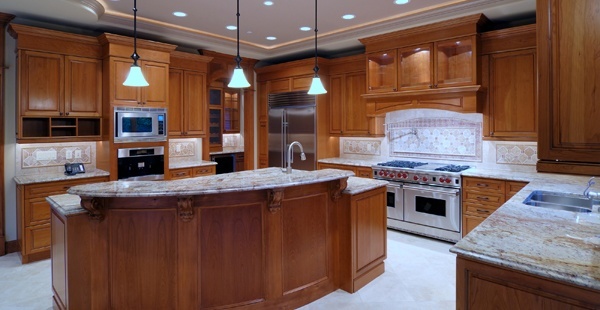
Being in the business enterprise of natural stone material specification and supply for over 25 years, I typically hear household owners as properly as hotel owners or their representatives repeat the identical lament, "that is too significantly, I can't afford that high priced material for my countertop(s)". Here is a very simple budget formula to calculate the price difference for that more pricey material that you really like, but believe you can't afford.
We will be working with polished granite as our example, but we could use anything. The point is, the material price is an independent entity, and you need to have to think of it that way. Countertop expense, whether or not in your kitchen, or in 250 hotel rooms, is figured just for budget purposes. The actual material expense is only about 25% of the actual expense of the countertop for your project. Fabrication expenses, job-web page measurements, transportation and installation costs make up the majority (75%) of what you are paying for given that it is especially labor intensive.
Let's say you locate an "average" priced granite ($12/SF raw material price) that you could live with, but you want another 1 that expenses twice as much, $24/SF raw material expense). You think the countertop fabrication enterprise priced the initially granite at about $two,000 for 40 SF of countertop surface installed in your kitchen. How can you afford $four,000 for this best? That is twice the cost, correct? But only the material expense has doubled. All the rest of the labor items stay the exact same fabrication, measuring, transport and installation.
Now take 75% (or three/4) of the unit price, $50 per SF. You would be $37.50/SF for the "labor" items. For our purposes this is constant, no matter what granite you decide on. This is not constantly true, as some granites are much more difficult to perform with than others, but for our purposes, we will not contemplate that. Now 25% (or 1/4) of that unit price amount ($50/SF) is $12.50/SF, the expense-plus profit for the raw material of the slab made use of for the fabrication. Now we substitute the new pricing of the even more high priced material, $25/SF (such as $1/SF for profit on the material). Add that to the "labor" items unit expense, or $37.50/SF.
This now equals $62.50/SF for the even more costly material, rather of the original $50 per square foot, or an enhance of $12.50 per SF. Now, the identical location of countertop, 40 SF, multiplied occasions $62.50/SF (the new unit price) equals $two,500 for the more costly countertop, not $four,000. Your net cost improve for the granite that costs twice is much is only $500, not the $1,500 you were thinking.
This very simple trick will assist you justify paying for the precise material that you desire and make you feel decent about performing so. Why not have what you want, rather of what you can live with, considering that you will be seeing it virtually everyday for very a even though.
This example has imaginary numbers to show the principle that substantial increases in the cost of supplies does not translate linearly to the final expense of the construction project. Material expenses are only a portion of any construction project, as this easy illustration shows us.
Charles B Kirkendall
Natural Stone Specification Consultant


